
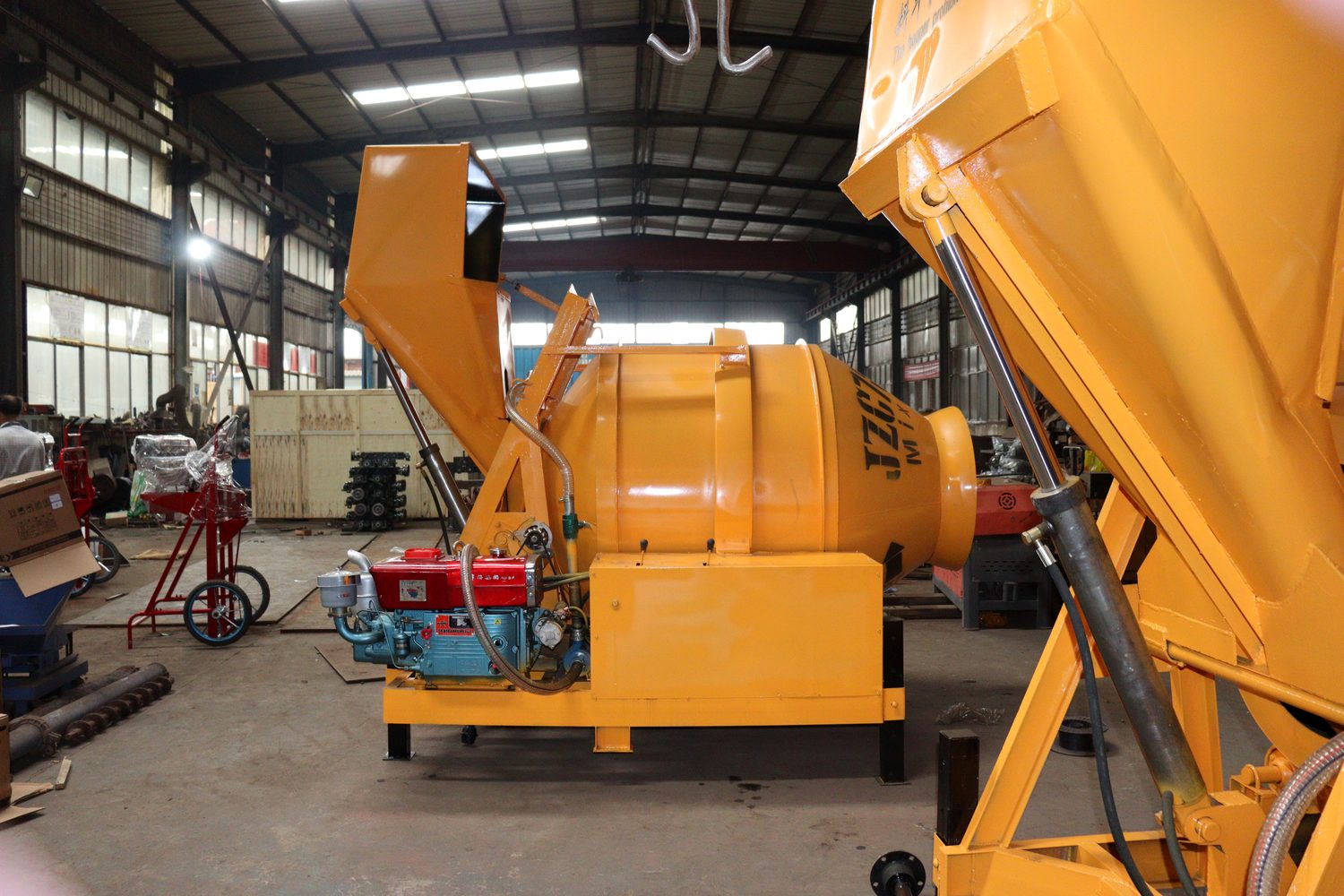
Before every start, check four items on a cement mixer: drum and blade wear, drive belt tension, engine or gearbox oil level, and the water system for leaks. A worn blade leaves unmixed material at the drum wall, which shows up as variable slump between batches.
Cement mixers rarely fail suddenly. They wear out in a predictable sequence, and almost every step in that sequence is visible a week before it becomes a repair. The reason the daily routine matters is that the checks take minutes while the breakdowns they prevent cost days — usually days when concrete is already on site.
Why the routine beats the repair
Two things cause most mixer damage, and both are cumulative rather than sudden. The first is set material. Mortar that is allowed to harden inside the drum does not just reduce the usable volume; it loads the drive on every subsequent start and eventually takes the blades with it. The second is overloading. A mixer run above its rated batch capacity wears the drive, the belt and the bearings, and produces a batch that is not properly mixed at the same time.
Before starting the machine
- Drum interior and blade wear. Look for build-up from the previous shift and for blades worn back to the point where they no longer fold the mix.
- Oil level and condition. On the diesel models this is the engine and the hydraulic system; check both, and look for water contamination rather than just topping up.
- Belts, guards and fasteners. A slack belt slips under load and shows up later as an engine that "will not hold speed".
- Free rotation. Turn the drum by hand before starting. Anything that catches is cheaper to find now.
- Diesel models only: fuel level and air filter. A clogged filter behaves exactly like a power problem.
During operation
- Batch from mixing capacity, never from drum capacity. The drum must have room for the material to tumble. This is the single most common cause of overload damage.
- Listen for a change in pitch. A steady note turning rough means load, not speed.
- Watch discharge. Sluggish discharge usually means build-up starting behind the blades.
- Keep the water addition consistent. Frequent small additions to "loosen it up" usually mean the batch was over-filled to begin with.
After the shift
Clean at the end of every shift, not the next morning. Fill the drum with water and a small amount of aggregate and let it turn; that removes the soft material that would otherwise set overnight. Once set, the same material has to be chipped out, and drum walls are not designed to be chipped.
Wash down the frame and the discharge chute as well. Material that sets around the chute distorts the discharge path, and the symptom — a batch that will not come out cleanly — appears long after the cause.
Weekly and monthly
- Grease the points listed in the machine's own manual, at the intervals it states.
- Check blade-to-drum clearance and retorque fasteners.
- Inspect hoses, seals and the water measuring system.
- For diesel units, service the engine on its own schedule — the mixer's reliability is capped by the engine's.
Specifications and what they mean for maintenance
| Model | Drum capacity | Mixing capacity | Productivity | Cement per batch | Weight |
|---|---|---|---|---|---|
| LY-500 Concrete Mixer | 500 L | 400 L | 6–8 m³/h | 1.5 bags | 330 kg |
| LY-500-DW Concrete Mixer | 500 L | 400 L | 8–10 m³/h | 1.5 bags | 1200 kg |
| LY-350 Diesel Concrete Mixer | 500 L | 400 L | 10–14 m³/h | 2 bags | 1800 kg |
Note the gap between the drum figure and the mixing figure in every row: a 500 L drum gives 400 L of mixing capacity. That difference is the mechanical allowance for the mix to tumble, and it is the number to batch against. The cement-per-batch column is the practical cross-check — if you are counting bags and it does not match the table, the batch is wrong.
Standards behind the routine
- EN 206 specifies concrete by performance, production and conformity, including the requirements batch production has to satisfy. Batching accuracy and consistent mixing are part of meeting it, and both depend directly on an overloaded or worn drum.
- ASTM C94/C94M is the equivalent specification for ready-mixed concrete in US practice, and ASTM C685 covers concrete produced by volumetric batching and continuous mixing — relevant where batching is done on site rather than delivered.
- EN 60204-1 is the electrical safety standard for machinery, which is why guards, isolation and emergency stop belong to the machine, not to operator habit.
- The machine's own manual is the authority for grease points, torque figures and service intervals. Follow it over any generic checklist, including this one.
What goes wrong on site
- Batching to the drum figure. Overloads the drive and under-mixes the batch at the same time.
- Cleaning the next morning. Set material is several times harder to remove and damages the drum on the way out.
- Topping up oil without looking for the leak. The level looks right and the problem is unchanged.
- Air filter treated as a consumable that can wait. It is the most common cause of a diesel mixer that loses power under load.
- Material left around the discharge chute. Discharge gets progressively worse and the cause is invisible.
Frequently asked questions
How often should a cement mixer be cleaned?
At the end of every shift. Mortar left in the drum sets hard and is far harder to remove the next morning, and build-up against the blades reduces the effective mixing capacity of every subsequent batch.
What should be checked before starting the machine?
Drum condition and blade wear, oil level, the condition of the belt and guards, and that the drum turns freely by hand. On diesel models check fuel level and the air filter at the same time, because a clogged filter shows up as a machine that will not hold speed under load.
What is the most common cause of mixer damage?
Overloading. A 500 L drum gives 400 L of mixing capacity, and batching to the drum figure overloads the drive while producing a batch that is not properly mixed. Always calculate batches from the mixing capacity, not the drum size.
Need equipment for your next project?
Send us your requirement and we will recommend the right model.
Request a quotation