
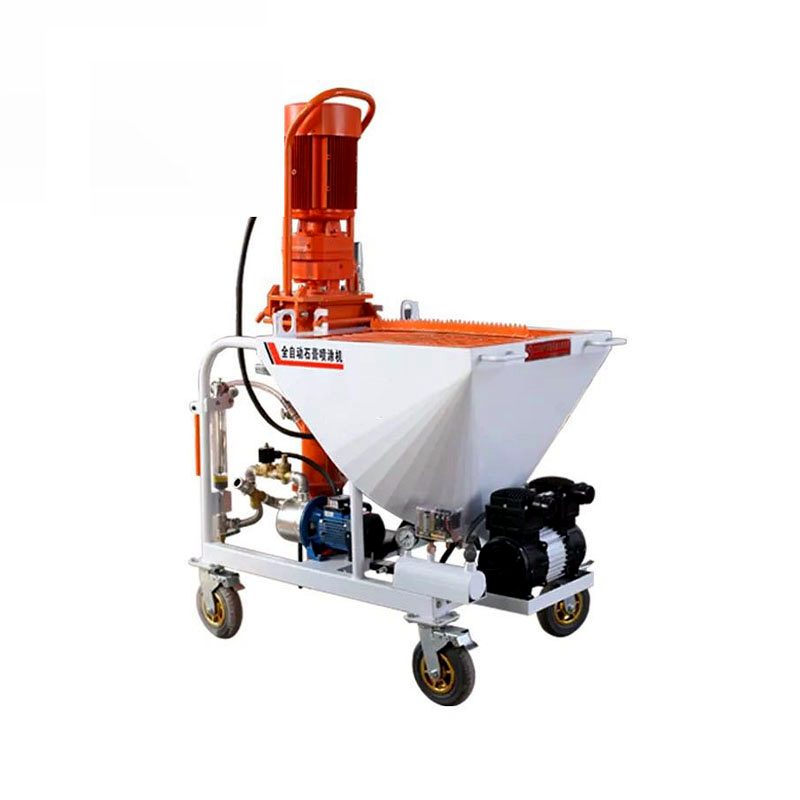
For an even indoor gypsum finish, mix to a pourable slurry, hold the nozzle 300–400 mm from the wall at 90 degrees, apply in two passes of 3–5 mm rather than one thick coat, and polish the surface with a wall polisher once the gypsum has begun to set but before it hardens.
Interior gypsum work punishes speed. The same machine and the same mix that produce a good exterior render in one pass will leave joint lines, ridges and overspray on an interior wall, because nothing about the job is the same except the equipment. Gypsum sets faster, the finish is judged at arm's length under raking light, and the room usually has to be handed back occupied. The technique below is what actually separates a clean interior job from a cheap one.
Why interior gypsum is a different job
- Setting time. Gypsum plasters set quickly. The working window between spraying and trowelling is short, and it does not extend because the machine is running slowly.
- Inspection distance. An exterior elevation is judged from the ground. An interior wall is judged from a metre away, often with a light raking across it.
- Overspray has nowhere to go. Outside it lands on the ground. Inside it lands on floors, frames, glazing and finished surfaces that are expensive to clean.
- The building is in use. Dust, noise and access are part of the specification.
Set up before the machine starts
Everything that makes an interior job look clean is done before the first bag is opened:
- Mask and sheet floors, frames, sills and anything already finished. Do this properly — it is far cheaper than cleaning off, and gypsum bonds well enough to be genuinely difficult to remove.
- Seal the doorways between the working area and the rest of the building, and plan dust extraction if the space is occupied.
- Confirm the substrate: clean, sound, and within the moisture and absorption range the plaster manufacturer specifies. Spraying onto a dusty or over-absorbent background produces a finish that fails at the adhesion layer, not at the surface.
- Lay the hose run out before you start, not while the machine is running.
Keep the nozzle clean
On gypsum the nozzle is the first thing to clog and the last thing to be blamed. A partially blocked nozzle sprays an uneven pattern, and the usual reaction — more pressure — makes it worse and consumes material. Get into the habit of clearing the nozzle at every hopper refill, not just when the pattern looks wrong. A two-second wipe at each refill prevents the twenty-minute stall and the rough patch it leaves behind.
Control the output — do not run at maximum
Interior work is where machine capacity should be deliberately unused. Run delivery at a rate you can trowel continuously, and let that set the pace. Short bursts at maximum output produce thick local deposits that take longer to flatten than they saved, and on a fast-setting material the joint between one burst and the next has already started to set by the time you reach it.
The 850 Double-Speed Mortar Spraying Machine is well suited to this because it runs at two speeds: a lower rate for finish work and a higher one for large surface areas, without changing machines.
Work in a steady rhythm
- Ceilings before walls. Material that falls from a ceiling onto a freshly sprayed wall has to be cut back; the reverse does not happen.
- One wall at a time, full width. Stopping mid-wall leaves a joint you cannot trowel out.
- Keep the nozzle distance constant. Varying distance changes both coat thickness and pattern width, and the variation shows up most in raking light.
- Watch the hopper level. Running the hopper empty aerates the mix and produces a spitting pattern along a strip of wall.
Plan for occupied buildings
In refurbishment the constraint is often the client, not the plaster. Agree working hours, agree which routes the machine and material will use, and agree how the space will be handed back each evening. Deciding this in advance is what allows a machine to be used in a building that is still trading.
Machine choice for interior gypsum
| Model | Output | Throughput | Conveying height | Hopper | Power |
|---|---|---|---|---|---|
| LY-60 Multi-Function Plaster Spraying Machine | 400 m²/h | 30 L/min | 15 m | 115 L | 5500 W |
| 850 Double-Speed Mortar Spraying Machine | 150 m²/h (low speed) / 250 m²/h (high speed) | - | 30 m | 130 L | 7.5 kW / 9 kW |
| 417 Mortar Spraying Machine | 80 m²/h | - | 10 m | 50 L | 4 kW |
Standards that apply to gypsum work
- EN 13279-1 defines gypsum binders and gypsum plasters and states the requirements they have to meet. It is the reference behind the setting behaviour and the product classification you are working to.
- EN 13914-2 covers design considerations and essential principles for internal plastering, including the backgrounds and preparation that interior gypsum depends on.
- EN 13914-1 is the external rendering counterpart, and is the standard to follow when the same machine is used outside on the same site.
- EN 1015 is the test-method family for masonry mortar, including fresh mortar properties — useful when a specified consistency has to be reproduced batch after batch.
What goes wrong on site
- Running at maximum output. The standard cause of ridges, joint lines and heavy cutting back on interior walls.
- Nozzle neglect. A partially blocked nozzle adds pressure that is not there; the pattern gets worse and material consumption rises together.
- Inadequate masking. Gypsum sets hard on finished surfaces and will not simply wipe off after the fact.
- Walls before ceilings. Falling material ruins the wall finish and the recovery time exceeds the original saving.
- Spraying onto an unprepared background. Absorption and adhesion problems develop under the surface and only appear after decoration.
- Letting the hopper run empty. Aerated mix sprays unevenly and leaves a visible strip.
Frequently asked questions
Can one machine spray both gypsum and cement mortar?
Yes. The 850 double-speed plaster spraying machine handles both: 150 m²/h (low speed) / 250 m²/h (high speed), so you can run a lower delivery rate for finish work and a higher one for large surface areas without changing machines.
Why does indoor gypsum work need a lower output?
Gypsum sets quickly and an interior finish is judged at close range. Running delivery faster than you can trowel leaves joints that have to be cut back, and cutting back costs more time than the higher output saved.
How do I keep overspray off finished surfaces?
Mask and sheet before starting, do the ceiling before the walls, and keep a steady rhythm rather than short bursts at high output. Pulsing delivery is what puts material where it is not wanted, and cleaning it off costs more than the time it saved.
Need equipment for your next project?
Send us your requirement and we will recommend the right model.
Request a quotation