
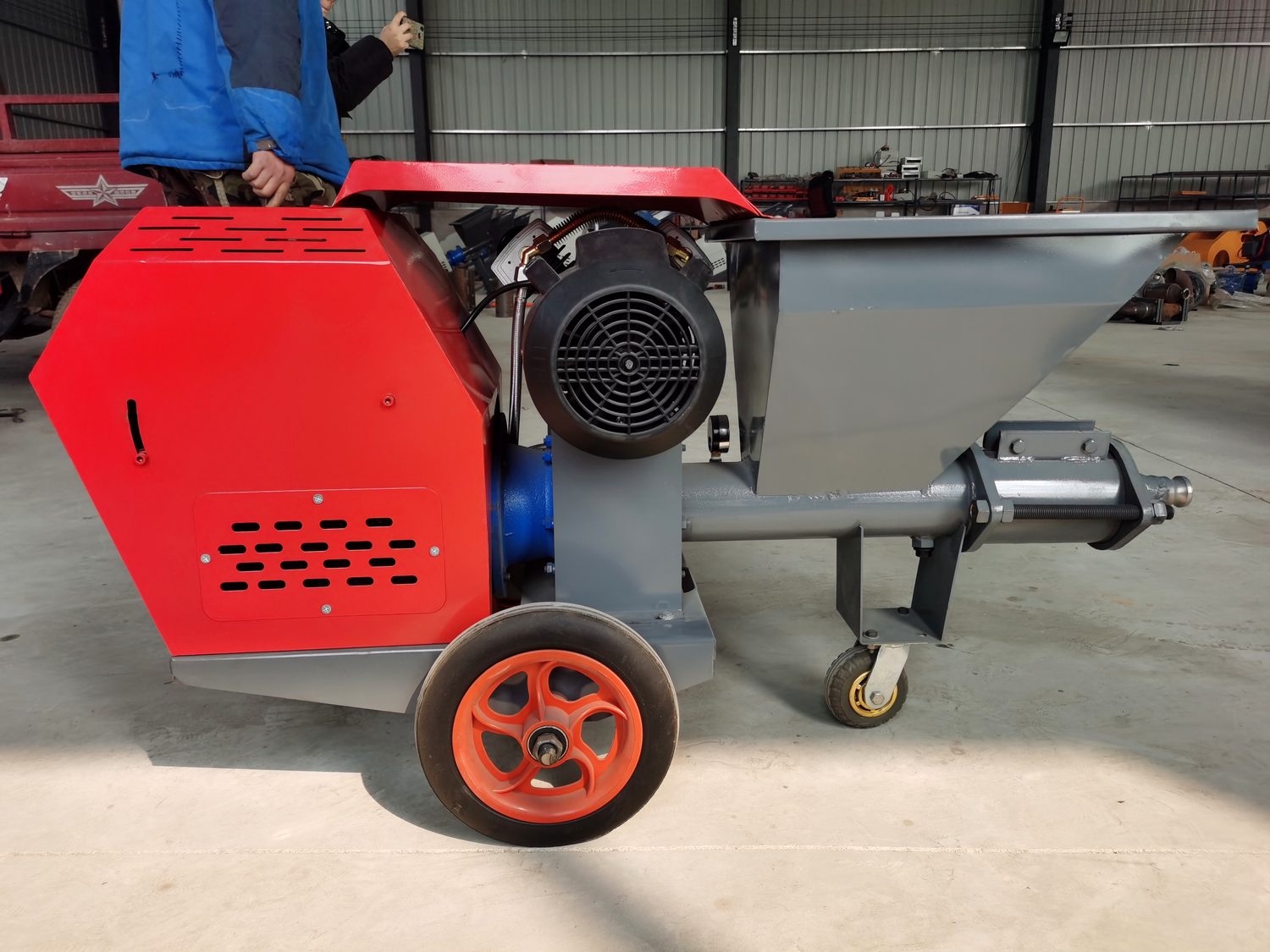
Most mortar sprayer faults trace to three causes: mix too dry (blockage), particles above the machine's stated capacity (blockage), or a worn nozzle or valve seat (pulsating and uneven spray). Check mix water content first, then particle size against the spec, then inspect the nozzle and ball valve.
When a spraying machine misbehaves it is almost always telling you something specific. The four symptoms below cover the large majority of site call-outs, and each one has a short list of likely causes.
Symptom 1: The hose blocks repeatedly
Likely causes:
- Aggregate too large for the machine. Every model has a maximum conveying particle size. Exceeding it is the single most common cause of repeated blockage.
- Mix too stiff. A mix that is workable by hand may still be too dry for pumping. Slightly increasing workability usually resolves it.
- Pressure margin exhausted. If the job is at or near the machine's maximum conveying height or distance, there is no reserve left for a stiffer batch. Check the rating against the actual hose run.
- Material left standing. Mortar begins to stiffen in the hopper and hose. Do not leave material in the machine during long breaks.
What to do: stop, relieve pressure, clear the affected section, then re-screen the mix and confirm particle size against the machine rating. If blockages are frequent at the same height, the machine is underspecified for the hose run — consider a model with more pressure.
Symptom 2: Pulsating or surging output
Likely causes: an inconsistent feed (hopper running low between refills), air entering at a hose joint, or a mix with inconsistent consistency between batches.
What to do: keep the hopper above minimum level; check and reseat all hose couplings; standardise the mixing procedure so each batch matches the last. Persistent pulsation with a good feed points to a wear part that needs replacing.
Symptom 3: Uneven spray pattern
Likely causes: a partially blocked or worn nozzle, incorrect air-to-material balance, or holding the gun at an inconsistent distance and angle from the surface.
What to do: clean or replace the nozzle first — it is the cheapest fix and the most common one. Then re-check gun distance. For ceilings, reduce output rather than increasing distance, since material applied too heavily will sag.
Symptom 4: Output drops but the motor is running normally
Likely causes: wear in the conveying parts, a partially obstructed hopper outlet, or a mix that has stiffened.
What to do: inspect wear parts and replace them on schedule. Wear parts are consumables; planning for them is cheaper than losing a day on site.
Prevention beats repair
- Screen your material. Match aggregate size to the machine rating.
- Standardise the mix. Consistency between batches prevents most pump problems.
- Clean immediately after use. Flush the hopper, pump and hose before material sets.
- Keep a spare nozzle and common wear parts on site.
- Do not run at the specification limit. Leave margin on height and distance.
Specify the right machine and half of these disappear
Most chronic blockage problems are specification problems. If your hose run approaches the limit of the 311 Mortar Spraying Machine at 10 m / 15 m, moving to the 711 Mortar Spraying Machine at 20 m or the M-11 High-Lift Mortar Spraying Machine at 50 m and 100 m horizontal solves the symptom permanently.
Need help with a specific machine?
Tell us the model, the material, the hose length and height, and what you are seeing. Our team can usually identify the cause from that description alone.
Standards that define a correct result
Troubleshooting is easier when you know what "correct" is defined as. Most of the symptoms below are only symptoms because the finished work must meet a specification.
- EN 13914-1 defines the preparation and application requirements for external rendering and internal plastering, including the substrate condition and the coat build-up. A machine that cannot hold a consistent output will not hold a specified coat thickness.
- EN 998-1 classifies rendering and plastering mortars by use and performance, and the declared working time of your mortar directly affects how long it can sit in a hopper or hose before it starts to stiffen.
- ASTM C926 is the equivalent application standard referenced on many North American and Gulf projects.
- EN 60204-1 covers the machine's electrical system — relevant when a fault appears to be electrical but the machine runs normally.
The practical link: if your mortar's declared working time is short, plan the spraying run around it rather than trying to dilute the mix to extend it.
What goes wrong on site
- Chasing blockage with water instead of fixing the cause. Repeated blockage at the same height is a specification problem — the machine has no pressure margin left for a stiffer batch. The fix is the next model up, not a thinner mix.
- Letting material stand during breaks. Mortar stiffens in the hopper and hose while the crew is away. A short flushing routine costs minutes; stripping a set hose costs hours.
- Running the hopper low. A starved hopper causes pulsation that shows up in the finish, and the operator usually blames the machine.
- Re-using worn nozzles. An uneven pattern is most often a worn or partly blocked nozzle, which is the cheapest part on the machine to replace.
- Inconsistent mixing between batches. A different consistency every batch reads as machine illness; standardising the mix usually resolves it outright.
Frequently asked questions
Why does my mortar sprayer keep blocking at the same height?
Repeated blockage at a consistent height almost always means the machine is running without pressure margin — the job is at or near its maximum conveying height for the mix being used. Check the aggregate against the machine maximum particle size, then consider a model with higher conveying pressure rather than diluting the mix.
What causes pulsating or surging output?
Three common causes: the hopper running low between refills, air entering at a hose coupling, and inconsistent consistency between batches. Keep the hopper above minimum, reseat all couplings, and standardise the mixing procedure. Persistent pulsation with a good feed points to a wear part.
How do I fix an uneven spray pattern?
Clean or replace the nozzle first, since a worn or partly blocked nozzle is the most common cause and the cheapest fix. Then check gun distance and angle. On ceilings, reduce output rather than standing further back, because material applied too heavily will sag.
Need equipment for your next project?
Send us your requirement and we will recommend the right model.
Request a quotation