
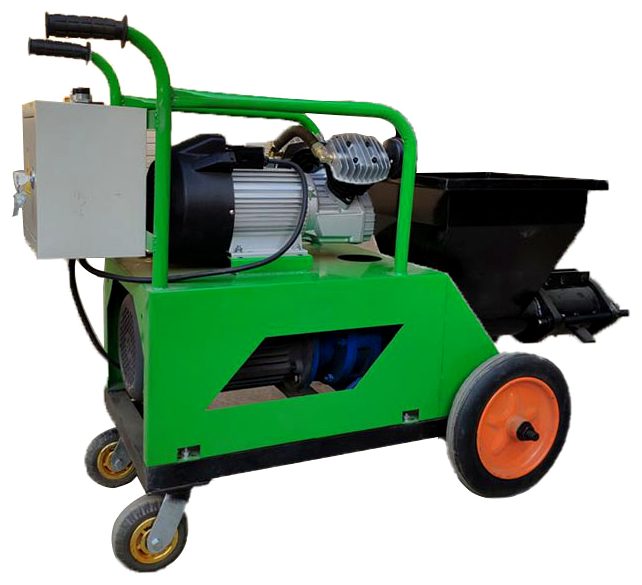
Machine spraying typically reaches 150–400 m²/h against 8–12 m²/h per plasterer by hand, and needs a two-person crew instead of four to six. The break-even point on a mid-range electric sprayer usually falls between 1,500 and 3,000 m² of plastering.
The honest answer is that a mortar sprayer is not always faster. It is faster when the work is continuous, flat and large enough to absorb the setup and clean-out time. On a single patch repair it is slower. Knowing where the line sits is what stops a machine purchase from becoming a disappointment, so this page sets out the comparison without the sales gloss.
What the machine changes, and what it does not
A sprayer changes one thing: it moves mortar from the hopper to the wall continuously, under pressure, without anyone carrying it. Everything downstream — screeding, trowelling, timing the finish — is unchanged. That single change is worth a great deal on the right job and very little on the wrong one.
Labour cost: where the saving actually comes from
Hand plastering is labour-heavy not because applying plaster is slow in itself, but because mortar has to be mixed, carried and placed by hand before anybody trowels it. The machine removes the carrying and the placing. It does not remove the trowelling, and on a job where one person was already trowelling flat out, the saving is limited to the second and third pairs of hands that were feeding them.
The practical rule: the saving scales with the area and with the crew you would otherwise need. A two-storey interior render is where machine spraying starts to pay; a bathroom ceiling is not.
Coating uniformity
Mixes applied by hand vary with how hard the plasterer presses and how the mortar sits on the trowel. Spraying replaces that variable with two controllable ones — pump pressure and nozzle distance — so an operator who holds both steady produces a more consistent coat thickness than hand work, and does it without a second person staging material.
Uniformity is also what makes the next stage cheaper. A consistent coat means less filling and less cutting back before the finish.
Material handling and the hopper
The machine moves the bottleneck rather than deleting it. Someone still has to keep the hopper fed, and the feeding method decides how much of the theoretical output you ever see. Bags tipped directly into a low-filling-height machine, a mortar pump feeding continuously, or a wheelbarrow shuttle all give different real outputs from the same machine.
The D-800 Mortar Spraying Machine and the DM9-25 Diesel Mortar Spraying Machine are both built with a low filling height, because they are meant to be fed from ground level by one person.
Where hand work still wins
- Small repair areas. Setup, hose priming and end-of-shift clean-out can exceed the whole job.
- Heavy detail and complex geometry. Beads, returns, reveals and intricate mouldings are faster by hand.
- Sites with no room for a machine and a hose run. Access decides more jobs than people expect.
- Very short shifts. A four-hour shooting window rarely repays the clean-out.
What still needs skill
Spraying does not deskill the trade; it relocates it. The operator now has to judge mix consistency, watch pressure and set the nozzle angle and distance — and the person on the trowel still decides flatness and texture. A crew that was good by hand is better with a machine. A crew that was not does not become good by buying one.
Side-by-side comparison
| Aspect | Manual plastering | Machine spraying |
|---|---|---|
| Labour to place the mortar | Two people, continuously | One operator plus a hod carrier |
| Output per day | Set by the crew | Set by the machine and the crew feeding it |
| Coating uniformity | Depends on hand pressure and rhythm | Set by hose pressure and nozzle distance |
| Material waste | Drop and rebound collected at the wall | Rebound still occurs; overspray must be controlled |
| Setup and clean-out | Tools only | Hose, rotor and hopper clean-out at the end of the shift |
| Mix requirement | Any workable mix | Must be pumpable and within the machine particle rating |
| Best suited to | Small areas, repairs, complex detail | Continuous flat areas with a crew to finish behind |
Machine options by job size
| Model | Output | Pressure | Conveying height | Hopper | Weight |
|---|---|---|---|---|---|
| 311 Mortar Spraying Machine | 50 m²/h | 3 MPa | 10 m | 50 L | 150 kg |
| 318 Mortar Spraying Machine | 60 m²/h | 4 MPa | 10 m | 50 L | 150 kg |
| 417 Mortar Spraying Machine | 80 m²/h | 3 MPa | 10 m | 50 L | 150 kg |
| 511 Mortar Spraying Machine | 150 m²/h | 3 MPa | 15 m | 100 L | 220 kg |
| 711 Mortar Spraying Machine | 200 m²/h | 5 MPa | 20 m | 130 L | 280 kg |
| 850 Double-Speed Mortar Spraying Machine | 150 m²/h (low speed) / 250 m²/h (high speed) | 5 MPa | 30 m | 130 L | 280 kg |
Standards that define a correct result
Both routes are measured against the same published requirements, which is why the comparison is about method and cost rather than about quality:
- EN 998-1 sets out how rendering and plastering mortar is classified and what performance is declared — the mortar specification applies whichever method places it.
- EN 13914-1 covers design, preparation and application of external rendering, including coat thickness and the interval between coats. Machine spraying makes a specified build-up easier to hold, it does not remove the requirement.
- EN 13914-2 covers internal plastering and the backgrounds it is applied to, which is where the preparation that matters most to finish quality is defined.
- ASTM C926 is the equivalent application specification for portland cement-based plaster in US practice, covering substrate preparation, lath and the coat sequence.
What goes wrong on site
- Buying capacity instead of a work method. A machine with no crew behind it produces less than hand work, not more.
- Unpumpable mix. Material has to be consistent and within the machine's conveying particle size. Re-screen anything that has picked up debris.
- Underestimating clean-out. If the hose and rotor are not cleaned at the end of the shift, the next morning starts with a blockage and a lost hour.
- Spraying faster than the finish can be worked. The most common cause of a poor job with a perfectly good machine.
- Ignoring rebound and overspray. Sheet and mask before starting; cleaning it off a finished surface costs more than the time it saved.
Frequently asked questions
Is machine plastering always faster than hand work?
No. Machine output only converts into finished square metres if the crew can keep up with material supply and trowelling. On small repair patches hand work is often faster, because setting up, priming the hose and cleaning out afterwards dominate the job.
What does machine spraying change about the material?
The mix has to be pumpable: consistent, free of oversized aggregate and within the machine stated conveying particle size. The 311 passes 3 mm, the 511 passes 4 mm and the 711 passes 5 mm. Re-screen or re-mix material that has been standing or has picked up debris.
Does a machine reduce the skill needed?
It removes the labour of placing the mortar, but the trowel stage is unchanged. Control of flatness, texture and the timing of the finish still decides the result, and that work is the same by hand or by machine.
Need equipment for your next project?
Send us your requirement and we will recommend the right model.
Request a quotation