
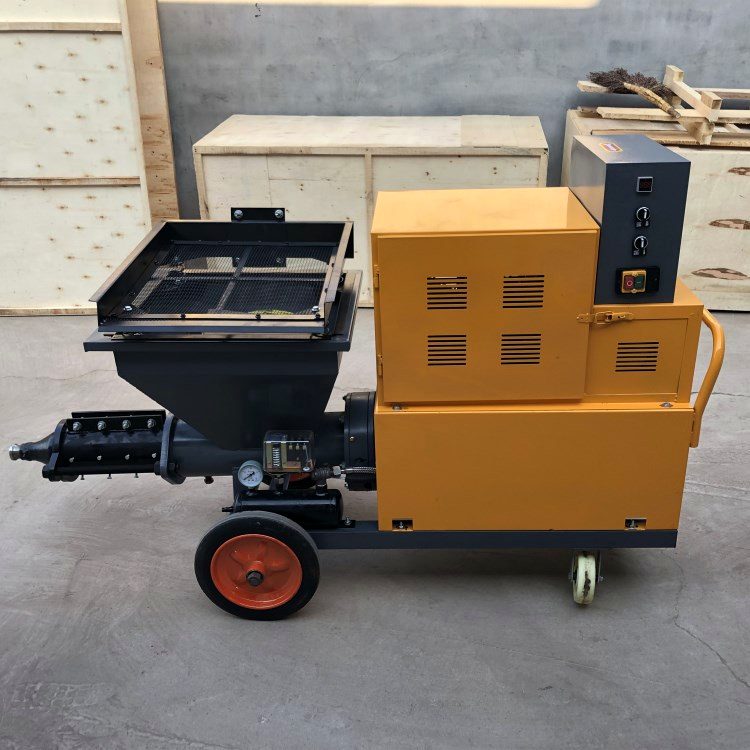
The LingGo mortar sprayer range steps up in output and pressure: 311 at 50 m²/h and 3 MPa, 318 at 60 m²/h and 4 MPa, 417 at 80 m²/h, 511 at 150 m²/h and 7.5 kW, 711 and 711X at 200 m²/h and 5 MPa, 850 at 250 m²/h in high gear, and M-11 at 400 m²/h with 50 m conveying height.
Eight machines, four questions: how much surface do you cover, how high do you need to push material, what power do you have, and how will you feed the hopper. The table below lists the real specifications of our mortar spraying range so you can shortlist without opening eight separate pages.
Specification comparison
| Model | Output | Pressure | Conveying height | Motor power | Hopper | Weight |
|---|---|---|---|---|---|---|
| 311 Mortar Spraying Machine | 50 m²/h | 3 MPa | 10 m | 4 kW | 50 L | 150 kg |
| 318 Mortar Spraying Machine | 60 m²/h | 4 MPa | 10 m | 4 kW | 50 L | 150 kg |
| 417 Mortar Spraying Machine | 80 m²/h | 3 MPa | 10 m | 4 kW | 50 L | 150 kg |
| 511 Mortar Spraying Machine | 150 m²/h | 3 MPa | 15 m | 7.5 kW | 100 L | 220 kg |
| 711 Mortar Spraying Machine | 200 m²/h | 5 MPa | 20 m | 7.5 kW | 130 L | 280 kg |
| 711X Mortar Spraying Machine | 200 m²/h | 5 MPa | 20 m | 7.5 kW | 130 L | 280 kg |
| 850 Double-Speed Mortar Spraying Machine | 150 m²/h (low speed) / 250 m²/h (high speed) | 5 MPa | 30 m | 7.5 kW / 9 kW | 130 L | 280 kg |
| M-11 High-Lift Mortar Spraying Machine | 400 m²/h | 6 MPa | 50 m | 11 kW | 70 L | 550 kg |
How to read the table
Output ranks the machines, but treat it as a ceiling measured under ideal continuous conditions. Pressure is what actually moves material up and along the hose. Conveying height is the vertical limit — exceed it and you will fight blockages rather than gain speed. Motor power tells you what electrical supply you need. Hopper volume determines refill frequency. Weight determines whether two people can move it.
Which model for which job
- 311 Mortar Spraying Machine — 50 m²/h, 3 MPa, 10 m lift, 150 kg. Small interior jobs, tight access, single-phase supply available.
- 318 Mortar Spraying Machine — 60 m²/h, 4 MPa. A step up where slightly higher pressure is needed without moving to a large machine.
- 417 Mortar Spraying Machine — 80 m²/h. Mid-size contractor work where a compact machine runs out of pace but a 7.5 kW unit is not yet justified.
- 511 Mortar Spraying Machine — 150 m²/h at 7.5 kW. Daily contractor use on walls and ceilings; the most common all-round choice.
- 711 Mortar Spraying Machine — 200 m²/h, 5 MPa, 20 m lift and a 130 L hopper. Large sites with a crew big enough to keep it fed.
- 711X Mortar Spraying Machine — 200 m²/h. The 711 platform with the variations required for heavier continuous duty.
- 850 Double-Speed Mortar Spraying Machine — 150 m²/h (low speed) / 250 m²/h (high speed). Double-speed drive lets you drop output for ceilings and finishing, then raise it for open wall areas.
- M-11 High-Lift Mortar Spraying Machine — 400 m²/h, 6 MPa, 50 m vertical and 100 m horizontal. Multi-storey façades and long hose runs.
Three specification mistakes to avoid
1. Checking height but not distance
Every model quotes a vertical and a horizontal limit. A site that needs 15 m of lift but 40 m of hose from the parking point can exceed the horizontal rating of a machine whose height rating looks sufficient.
2. Ordering the wrong voltage
Several models are offered at 380 V or 220 V. Confirm your supply before ordering — this is the most common cause of a machine arriving and not being usable.
3. Ignoring how the hopper is fed
A high-capacity machine with a small hopper stops often unless you have a mixer discharging into it. Match hopper volume to your supply method: hand-bagged material needs more hopper, or a slower machine.
Not sure between two models?
Send us the surface type, daily square metres, maximum height and available power. We will tell you which of these eight fits and, just as usefully, which ones are more machine than you need.
Standards that apply to the work
The models differ, but the compliance requirement does not: whichever machine you choose, the finished coating has to satisfy the same specification.
- EN 998-1 classifies rendering and plastering mortars by use and declared performance. This matters because a one-coat (OC) product and a general-purpose (GP) product place different demands on a machine's throughput and pressure.
- EN 13914-1 governs preparation and application, including the number of coats and the substrate conditions that must be met before spraying starts. A machine that cannot hold a controlled output will struggle to meet a specified coat thickness consistently.
- EN 1015 is the test-method family for masonry mortar, including the fresh and hardened mortar tests your supplier's product data sheet will quote against.
- ASTM C926 is the equivalent application standard used on many North American specifications.
Ask your client which of these their specification names, then match the machine's output and pressure to the coat build-up rather than to the floor area alone.
What goes wrong on site
- Under-specifying pressure to save cost. The symptom is not a slow machine — it is repeated blockage at height. If a job is near the conveying limit, choose the next model up rather than relying on a thinner mix to compensate.
- Choosing a hopper too small for the crew. A large-capacity machine with a small hopper spends its time waiting to be filled. If material arrives by the bag, either size the hopper up or size the machine down.
- Forgetting that weight is a specification. A 550 kg high-lift unit needs a loading plan and floor capacity; a 150 kg compact unit can be carried through a standard doorway. On scattered small sites, portability often beats capacity.
- Buying capacity you cannot feed. The bottleneck is nearly always material supply, not spraying. Pair a high-output machine with a mixer discharging into it, or accept a lower-output model.
Frequently asked questions
What is the difference between the 311 and the 711?
Output and reach. The 311 is rated at 50 m2/h with 3 MPa pressure and 10 m conveying height; the 711 is rated at 200 m2/h with 5 MPa, 20 m conveying height and a 130 L hopper. The 711 suits large sites with a crew that can keep it fed.
Which model do I need for multi-storey facade work?
Start from the conveying height and hose run rather than the floor area. The M-11 is rated to 50 m vertical and 100 m horizontal, which is the realistic starting point for multi-storey facades; choosing a smaller machine and upgrading later usually costs more.
Why does voltage matter so much when comparing models?
Several models are offered at 380 V or 220 V, and a machine ordered at the wrong voltage cannot be used on site at all. Confirm your supply before ordering, and remember to check that it can carry the motor starting current alongside other site loads.
Need equipment for your next project?
Send us your requirement and we will recommend the right model.
Request a quotation