
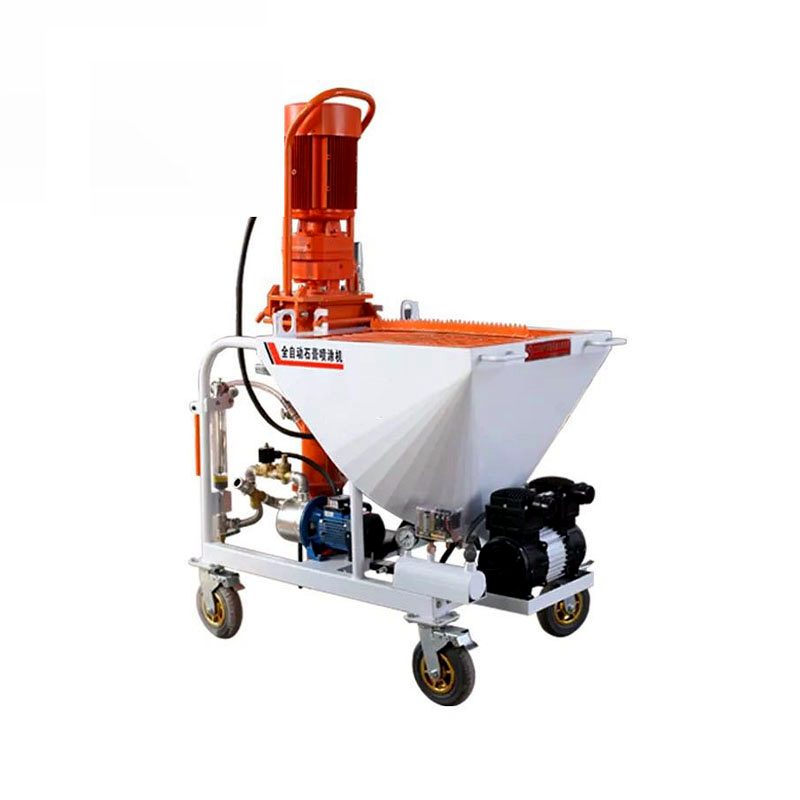
A gypsum sprayer and a mortar sprayer differ mainly in nozzle design and pressure: gypsum sets faster and needs an anti-clog nozzle with lower pressure, while mortar carries sand and needs higher pressure and a wear-resistant pump. For interior gypsum work the LY-60 is the match; for sand-cement render the 417 or 511.
Gypsum and cement-based mortar are different materials with different pumping behaviour, and the machines optimised for them differ in throughput, particle tolerance and how the finish comes off the wall.
What changes with gypsum
- Finer material. Gypsum plasters are finer than cement render, so particle tolerance requirements differ.
- Throughput matters. Interior finishing is often quoted in litres per minute as well as square metres per hour, because coverage depends heavily on coat thickness.
- Finish quality dominates. Interior surfaces often go straight to paint or skim, so consistency and a controllable spray pattern matter more than maximum rate.
- Lower height, shorter runs. Interior work rarely needs the 50 m lift that a façade machine does, so reach is less of a constraint than finish.
Our multi-function plaster spraying machine
The LY-60 Multi-Function Plaster Spraying Machine is built for this class of work: 400 m²/h, 30 L/min throughput, 15 m conveying height and 25 m horizontal, with a 115 L hopper and a filling height of 90 cm so it can be loaded comfortably by hand or from a mixer. At 5500 W it runs on a standard industrial supply.
Because it is specified for finer plastering material with a larger particle tolerance than a cement render machine, it suits interior finishing, gypsum work and light plastering in a way a render-oriented machine does not.
Where a mortar sprayer is still the right choice
If your work is predominantly exterior rendering, blockwork coating or fireproofing with cement-based material and coarse aggregate, a mortar spraying machine such as the 511 Mortar Spraying Machine or 711 Mortar Spraying Machine is the correct tool. The distinction is material and finish, not just output.
Many contractors doing both interior and exterior work run two machines. If you can only own one, decide by which material you spray most often — and note that the LY-60 Multi-Function Plaster Spraying Machine is a genuine multi-function plastering machine rather than a single-purpose unit.
Practical interior spraying tips
- Keep the gun at a consistent distance and angle; most uneven finishes are technique, not machine.
- Reduce output on ceilings rather than standing further back.
- Keep the hopper fed — a starved hopper causes pulsation that shows in the finish.
- Clean the machine thoroughly at the end of the day; set plaster is far harder to remove than wet.
Choosing
Interior finishing with gypsum or fine plaster: start with the LY-60 Multi-Function Plaster Spraying Machine. Exterior or coarse cement render: start with the mortar spraying range. Tell us your material, coat thickness and daily square metres and we will confirm.
Standards that separate gypsum work from cement render
The materials behave differently because they are covered by different standards, and those differences are the whole reason two machines exist.
- EN 13279-1 is the European standard for gypsum binders and gypsum plasters, defining their types and performance. Interior finishing work in Europe is normally specified against this, not against the cement-based rendering standards.
- EN 998-1 covers rendering and plastering mortars, the cement-based family. Applying a one-coat product versus a general-purpose product changes the throughput and finish requirements placed on the machine.
- EN 13914-1 covers the design and application of external rendering and internal plastering, which is where the required coat build-up is defined.
- ASTM C926 is the North American equivalent for portland cement-based plaster application.
The practical consequence for a buyer: material choice drives machine choice. A machine specified for fine gypsum plaster is a different tool from one specified for cement render with coarse aggregate, even when both quote similar output figures.
What goes wrong on site
- Spraying gypsum through a render-oriented machine. The wrong machine for the material shows up as poor finish consistency and, in some cases, pumping problems rather than an obvious failure.
- Mixing standards between areas. If part of a building is finished in gypsum and part in cement-based plaster, treating the two as interchangeable in the programme causes rework at the junctions.
- Applying too heavily to ceilings. The most common cause of sagging is standing further back and increasing output instead of reducing it.
- Leaving set plaster in the machine. Set gypsum is significantly harder to remove than set cement render, so end-of-day cleaning matters more, not less.
Frequently asked questions
Do I need a different machine for gypsum than for cement render?
In practice yes. Gypsum plasters are covered by EN 13279-1 and are finer than cement render, so throughput and finish control requirements differ. A machine specified for fine plastering such as the LY-60 suits interior finishing, while a cement-render machine such as the 511 or 711 is the correct tool for exterior rendering with coarse aggregate.
Can one machine do both interior and exterior work?
The LY-60 is a genuine multi-function plastering machine rather than a single-purpose unit, so it covers a range of plastering materials. Where work is predominantly exterior rendering with coarse aggregate, a mortar spraying machine is still the more appropriate tool, and many contractors running both types keep one of each.
Why does my interior finish come out uneven?
Most uneven interior finishes are technique rather than machine: inconsistent gun distance and angle, or a hopper running low and causing pulsation. Reduce output on ceilings rather than standing further back, and keep the hopper fed.
Need equipment for your next project?
Send us your requirement and we will recommend the right model.
Request a quotation