
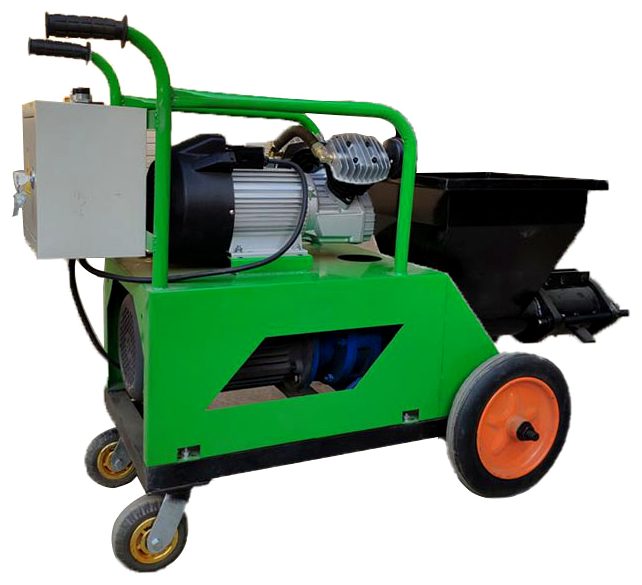
Choose a mortar sprayer by answering five questions in order: what material, how many m² per day, how high and how far, what power is available, and what budget. Material sets the pump type, area and height set the output and pressure, and power availability decides between the electric and diesel ranges.
Most mortar sprayer enquiries start with the wrong question — "which model has the highest output?" Capacity is the easiest number to compare and the least useful one to buy on. In practice four things decide whether a machine earns its money on your site: what the substrate will accept, what your crew can keep up with, how far and how high the material has to travel, and what power you actually have on site. This guide works through them in that order.
1. Start from the surface and the material, not the machine
A sprayer has to push a specific mix through a specific hose to a specific wall. That is a material-handling problem before it is a capacity problem. Two properties decide most of it:
- Maximum particle size in the mix. Every machine is rated for a conveying particle size. The 311, 318 and 417 pass 3 mm, the 511 passes 4 mm and the 711 passes 5 mm. A mix with aggregate coarser than the rating will bridge at the rotor and block, no matter how much pressure the pump can develop.
- Set behaviour of the material. Cement render, gypsum plaster and one-coat products behave differently in a hose. Gypsum sets fast and tolerates far less standing time, which is why interior finish work is usually run at lower output than the machine is capable of.
Get the material wrong and no amount of capacity compensates. Get it right and the rest of the sizing is straightforward arithmetic.
2. Match output to the crew, not to the building
A machine's rated capacity is a ceiling under good conditions, not a production rate. Real output is set by the slowest link in the chain — usually the person trowelling, or the person keeping the hopper fed.
So size from the area your team can prepare, spray and finish in one working day. If your crew finishes 120 m² a day, a machine rated far above that just means more material sitting in the hose while somebody catches up. The labour saving that makes machine spraying worthwhile comes from continuous flow, and continuous flow is a crew question, not a machine question.
3. Conveying height and distance decide more jobs than capacity
Vertical rise is where most site surprises come from. Pumping to the fourth floor is a different job from spraying a ground-floor elevation, and the two numbers are rated separately:
| Model | Output | Pressure | Conveying height | Conveying distance | Hopper | Weight |
|---|---|---|---|---|---|---|
| 311 Mortar Spraying Machine | 50 m²/h | 3 MPa | 10 m | 15 m | 50 L | 150 kg |
| 318 Mortar Spraying Machine | 60 m²/h | 4 MPa | 10 m | 15 m | 50 L | 150 kg |
| 417 Mortar Spraying Machine | 80 m²/h | 3 MPa | 10 m | 15 m | 50 L | 150 kg |
| 511 Mortar Spraying Machine | 150 m²/h | 3 MPa | 15 m | 25 m | 100 L | 220 kg |
| 711 Mortar Spraying Machine | 200 m²/h | 5 MPa | 20 m | 30 m | 130 L | 280 kg |
| 850 Double-Speed Mortar Spraying Machine | 150 m²/h (low speed) / 250 m²/h (high speed) | 5 MPa | 30 m | 50 m | 130 L | 280 kg |
| D-800 Mortar Spraying Machine | 150 m²/h | 3 MPa | 15 / 20 m | 20 / 30 m | 100 L | 300 kg |
| DM9-25 Diesel Mortar Spraying Machine | 200 m²/h / 4–6 m³/h | see product page | 40 m | 65 m | 85 L | 720 kg |
| D-25 Diesel Mortar Spraying Machine | 200 m²/h | 6 MPa | 40 m | 60 m | 70 L | 680 kg |
| M-11 High-Lift Mortar Spraying Machine | 400 m²/h | 6 MPa | 50 m | 100 m | 70 L | 550 kg |
Read the two columns together. The 850 double-speed reaches further than the 711 despite a similar power rating, because it is designed around a longer hose run. If your work is high-rise or the machine has to sit a long way from the workface, choose on height and distance first and accept whatever capacity comes with it. The M-11 High-Lift Mortar Spraying Machine is the extreme case: 50 m of vertical lift and 100 m of horizontal run, for towers and silos where nothing else in the range will reach.
4. Power source: three-phase, single-phase or diesel
The 311, 318 and 417 are offered in 380 V or 220 V; the 511 and 711 are 380 V three-phase. That single line decides several models for you.
- Reliable three-phase on site — the widest choice, and the cheapest way to get high output.
- Only single-phase available — the smaller models, or accept a reduced duty cycle on long runs.
- No power at all, or a site where the supply is temporary — a diesel machine. The D-25 Diesel Mortar Spraying Machine runs on its own 25 HP engine, and the DM9-25 Diesel Mortar Spraying Machine can run on diesel or switch to 380 V, which suits projects that start before the permanent supply is connected.
5. Hopper volume, filling height and how you will feed it
Hopper size is really a question about who stands next to the machine all day. A 50 L hopper means frequent refills; a 130 L hopper means fewer stops but more weight on the machine. Neither is better in the abstract.
What matters is that the feeding method is decided before the machine arrives: bags tipped straight in, a mortar pump feeding the hopper, or a wheelbarrow and shovel. If the filling height of the machine does not suit the way material reaches it, you have bought a bottleneck. The D-800 Mortar Spraying Machine and the DM9-25 Diesel Mortar Spraying Machine both use a low filling height for exactly this reason — they are designed to be fed by hand from ground level.
6. Weight, dimensions and site access
Check the machine against the tightest point on your site, not against the delivery truck. A machine that reaches the workface is worth more than a bigger one that stops at the stairwell. Compare the widest dimension of the chassis against your narrowest doorway, lift car and scaffold opening before you order.
7. Voltage and plug type — the mistake that cannot be fixed on arrival
Confirm the supply that will still be there in six months: phase, voltage and frequency. Ordering 380 V three-phase into a site that only ever has 220 V single-phase is the single most common specification error we see, and it cannot be corrected with an adapter.
8. Shortlisting from the range
| Model | Output | Pressure | Conveying height | Hopper | Weight |
|---|---|---|---|---|---|
| 311 Mortar Spraying Machine | 50 m²/h | 3 MPa | 10 m | 50 L | 150 kg |
| 318 Mortar Spraying Machine | 60 m²/h | 4 MPa | 10 m | 50 L | 150 kg |
| 417 Mortar Spraying Machine | 80 m²/h | 3 MPa | 10 m | 50 L | 150 kg |
| 511 Mortar Spraying Machine | 150 m²/h | 3 MPa | 15 m | 100 L | 220 kg |
| 711 Mortar Spraying Machine | 200 m²/h | 5 MPa | 20 m | 130 L | 280 kg |
| 850 Double-Speed Mortar Spraying Machine | 150 m²/h (low speed) / 250 m²/h (high speed) | 5 MPa | 30 m | 130 L | 280 kg |
Standards that apply to the choice
The machine you choose does not change the specification the finished coating has to meet, but it does change your ability to meet it consistently. Three published standards frame the decision:
- EN 998-1 classifies rendering and plastering mortar by use and declared performance. A one-coat (OC) product and a general-purpose (GP) product place different demands on throughput and pressure, so the mortar specification is an input to machine sizing.
- EN 13914-1 covers design, preparation and application of external rendering, including the substrate conditions and coat build-up that must be satisfied before spraying starts.
- EN 60204-1 is the electrical-equipment safety standard for machinery. It is the reason the site supply — earthing, protection and the available fault current — belongs in the specification conversation, not in a footnote.
Cite the standard your project is being built to when you request a quotation. It changes the recommended configuration more often than buyers expect.
What goes wrong on site
- Machine oversized for the crew. High output held back by trowelling speed produces cold joints and rework — the extra capacity is paid for twice.
- Particle size ignored. A mix with aggregate above the machine's rating blocks at the rotor. Re-screen, or move up the range.
- Height checked but distance forgotten. A 25 m hose run across a floor is as demanding as 15 m of vertical lift, and the hose routing usually has more bends than anyone planned for.
- Voltage assumed from the last project. Phase and voltage differ between sites in the same city, let alone between markets.
- Access checked at the door only. The last 20 m to the workface is where machines actually get stuck.
Send us the surface, the material, the daily area, the height and run, and the site voltage, and we will confirm the model and the configuration in writing.
Frequently asked questions
What output do I need for a normal two-storey house?
Size from the area your crew can prepare, spray and finish in one working day, not from the total floor area of the building. The 50 m²/h and the 80 m²/h cover most two-storey interior render once preparation and curing time are allowed for. Send us the daily area and the crew size and we will confirm the model.
Does conveying height decide the model?
It can. The 311, 318 and 417 are rated to 10 m vertically, the 511 to 15 m and the 711 to 20 m. If work goes above the second floor, choose on height first and output second - a machine with the right capacity but too little height is a blocked hose, not a slow machine.
What voltage should I specify?
The 311, 318 and 417 are offered in 380 V or 220 V; the 511 and 711 are 380 V three-phase. Confirm the supply available on site before ordering. Ordering the wrong voltage is the single most common specification error we see and it cannot be corrected on arrival.
Need equipment for your next project?
Send us your requirement and we will recommend the right model.
Request a quotation