
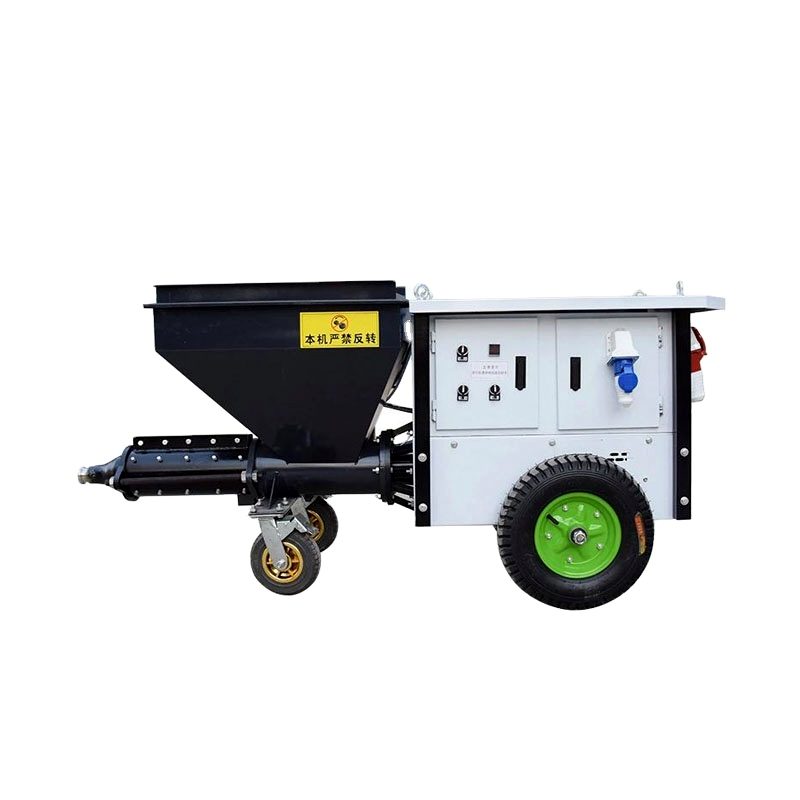
To size a mortar sprayer, match three figures to the job: output in m²/h against the daily area, pressure in MPa against hose length and mix density, and conveying height against the highest point of application. A 50 m²/h unit suits interior rooms; 200 m²/h and 5 MPa is the threshold for exterior rendering above 15 m.
A mortar sprayer is a specification-driven purchase. Marketing photos look similar across the market, but the three numbers that decide whether a machine works on your site are production capacity, conveying pressure and conveying height. This guide explains what each one means, how they interact, and how to choose without over-buying.
1. Start with the surface and the material
Before comparing machines, define what you are spraying. Interior wall plastering, exterior rendering, ceiling work and fireproofing coating all behave differently. Interior finishing rewards a smooth, adjustable output; exterior rendering on blockwork tolerates a coarser spray and a higher hourly rate. Ceiling work is the demanding case: too much material arriving too fast will sag before it sets, so controllable output matters more than a headline m²/h figure.
Material preparation matters just as much. A sprayer can only move what it is fed. Check the maximum conveying particle size of the machine against your mix design — a machine rated for 3 mm will not comfortably pass a coarse render with larger aggregate.
2. Production capacity (m²/h): read it as a ceiling, not a promise
Capacity figures such as 50 m²/h or 200 m²/h are measured under continuous, ideal conditions with the hopper kept full and the hose short. Real site output is typically lower because of crew pauses, mixing time, repositioning and surface preparation. Use the published number to rank machines, then plan your schedule at a realistic fraction of it.
Practical approach: estimate the square metres your crew can finish and prepare per day, then choose a machine whose rated capacity sits comfortably above that figure. Buying far above your crew's finishing speed adds weight, power demand and cost without adding completed square metres.
3. Conveying pressure: the number that decides whether material moves
Pressure, quoted in MPa, is what pushes material through the hose. It interacts with hose length and height: every metre of lift and every bend costs pressure. If you specify a machine with too little pressure for your required height, the symptom is not a slow machine — it is a blocked one.
As a rule, taller work and longer hose runs demand higher pressure. Our range runs from 3 MPa on the compact 311 Mortar Spraying Machine up to 6 MPa on the M-11 High-Lift Mortar Spraying Machine, which is why the high-lift model is the choice for multi-storey façades.
4. Conveying height and distance
Maximum conveying height is quoted vertically; maximum conveying distance is quoted horizontally. They are separate limits and you should check both against your site layout. A common mistake is to check the height (say, 10 m on the 311 Mortar Spraying Machine) and ignore that the machine also has to push material 15 m horizontally from where it is parked.
If your jobs regularly go above the second floor, the M-11 High-Lift Mortar Spraying Machine at 50 m vertical and 100 m horizontal is the realistic starting point rather than an upgrade later.
5. Hopper volume and crew rhythm
Hopper capacity determines how often someone has to stop spraying and refill. A 50 L hopper on a compact machine means frequent refills unless you have a continuous supply arrangement; a 130 L hopper on the 711 Mortar Spraying Machine keeps a larger crew spraying. Match hopper size to how you will actually feed the machine — bagged material by hand, or a mixer discharging into it.
6. Power source: mains, diesel or both
Electric models are quieter, cleaner indoors and cheaper to run where three-phase power exists. Check the voltage carefully: several machines are offered at 380 V or 220 V, and ordering the wrong one is the single most common specification error we see. Where the site has no reliable power, diesel models such as the D-25 Diesel Mortar Spraying Machine remove the dependency entirely.
7. Weight, dimensions and access
Specification sheets end with weight and dimensions for a reason. A 150 kg compact unit can be moved by two people and taken through a standard doorway; a 550 kg high-lift machine needs a plan for loading, ramps and floor loading. If your work is spread across many small sites, portability may be worth more than raw capacity.
The full LingGo sprayer range at a glance
Every figure below is taken from the individual model specification sheets on this site. Final configuration, voltage and accessories are confirmed with your quotation.
| Model | Power supply | Output | Max conveying height | Best suited to |
|---|---|---|---|---|
| 311 | 220 V / 380 V electric | 50 m²/h | 10 m | Small interior rooms; lowest entry point in the range |
| 318 | 220 V / 380 V electric | 60 m²/h | 10 m | Interior walls needing a bit more pressure for longer hose runs |
| 417 | 220 V / 380 V electric | 80 m²/h | 10 m | Adjustable flow for fine finishes, putty and skim coats |
| 511 | 380 V electric | 150 m²/h | 15 m | Mid-size commercial plastering with three-phase power |
| 711 | 380 V electric | 200 m²/h | 20 m | Large-area plastering and rendering at 5 MPa |
| 711X | 380 V electric | 200 m²/h | 20 m | Same output as the 711 on an extended, more stable frame |
| 850 | 380 V electric | 150 / 250 m²/h | 30 m | Mixed thin and thick coats via the two-speed gearbox |
| D-25 | 25 HP diesel | 200 m²/h | 40 m | Remote sites without mains power; long hose runs at 6 MPa |
| D-800 | 12 / 18 HP diesel | 150 m²/h | 15–20 m | Diesel work with fast cleaning between mixes |
| DM9-25 | Diesel or 380 V | 200 m²/h | 40 m | Sites that start off-grid and get mains power later |
| M-11 | 11 kW electric | 400 m²/h | 50 m | High-rise and long-distance pumping up to 100 m |
| LY-60 | 380 V electric | 400 m²/h | 15 m | Indoor gypsum and plaster finishing with one machine |
How to use this table: pick the row whose max conveying height covers the tallest point you spray, then check that the power supply matches what is actually available on your site. Output then tells you how many square metres a crew can finish per hour at that configuration. The detailed 7-column comparison of the eight electric models is in the model comparison article.
8. A checklist you can send to any supplier
- Surface type and approximate square metres per project
- Material mix and maximum aggregate size (mm)
- Maximum vertical height and horizontal hose distance on site
- Available power: voltage, phase, and whether it is stable
- Crew size and how the hopper will be fed
- Access constraints: door widths, lifts, floor loading, transport
Send those six answers and a competent supplier can narrow eleven models down to two. If you would rather talk it through, our team can review your job details and recommend a model — send the same list through the enquiry form on any product page.
Standards that apply to this work
Mortar sprayers themselves are not covered by a single international product standard, but the work they do is heavily standardised, and those standards are what your client's inspector will check against. Knowing which one applies explains why a supplier asks about coat thickness, substrate and mix design rather than just output.
- EN 13914-1 — the European standard covering the design, preparation and application of external rendering and internal plastering. If your project is in Europe, this is usually the reference document for how the work must be prepared, applied and cured.
- EN 998-1 — the specification for rendering and plastering mortars, which classifies them by use and performance. It is the document that determines whether the mortar you intend to spray is a general-purpose (GP), cement-based (CR), lightweight (LW) or one-coat (OC) product.
- ASTM C926 — the standard specification for application of portland cement-based plaster, widely referenced in North American and Gulf projects.
- ASTM C1063 — the installation standard for lathing and furring that receives portland cement-based plaster, relevant when metal lath is part of the build-up.
Local building codes take precedence over any of these. The practical point for a buyer is that the standard fixes the coat thickness and preparation, and those two facts in turn fix the machine specification — which is why we ask for them on every quotation.
What goes wrong on site
The failures we see most often are specification failures rather than machine failures, and they almost always surface in the first week.
- Buying on output alone. A crew that can only finish 80 m² a day gains nothing from a 200 m²/h machine, and loses money on weight, power supply and hopper refills. Match the machine to the finishing rate, not the spraying rate.
- Checking height but not hose distance. Vertical limit and horizontal limit are separate. A machine parked 30 m from the work with 12 m of lift can be outside its rating even though the height figure looked comfortable.
- Ordering the wrong voltage. Several models are offered at 380 V or 220 V. This is the single most common reason a machine cannot be used on arrival.
- Ignoring the aggregate. A machine rated for 3 mm will not reliably pass a render whose aggregate is coarser. Re-screening the mix is cheaper than replacing the machine.
The pattern behind all four: the machine was chosen from a price list rather than from the job. Send the job details first and the correct model is usually obvious.
Frequently asked questions
Which standard applies to mortar spraying work?
The machine is not itself standardised, but the work is: EN 13914-1 covers the design and application of external rendering and internal plastering in Europe, EN 998-1 classifies the mortars used, and ASTM C926 and C1063 are commonly referenced on North American and Gulf projects. Local building codes take precedence.
Do I need a higher-output machine for a bigger building?
Only if your crew can finish and prepare the additional area. Output above your finishing rate adds weight, power demand and cost without adding completed square metres. Where the constraint is reach rather than speed, choose a model with greater conveying height instead.
What information do you need to recommend a model?
Surface type, approximate square metres per project, material and maximum aggregate size, maximum vertical height and horizontal hose distance, available power supply, crew size and how the hopper will be fed. Those seven answers are usually enough to narrow the range to one or two models.
Is a higher m²/h always better?
Not on its own. Capacity above what your crew can finish, prepare and cure is wasted. Weight, power requirement and hopper logistics all rise with capacity.
Can one machine do both walls and ceilings?
Yes, most plastering machines are designed for both. For ceilings, prioritise controllable output and consistent pressure over maximum capacity.
What if my site has no three-phase power?
Either choose a model available in single-phase 220 V, or choose a diesel-powered machine. Confirm the voltage before ordering — it is specified on every product page.
Need equipment for your next project?
Send us your requirement and we will recommend the right model.
Request a quotation